
UK ILR or Settled Status: Does It Get You a UAE Visa on Arrival?
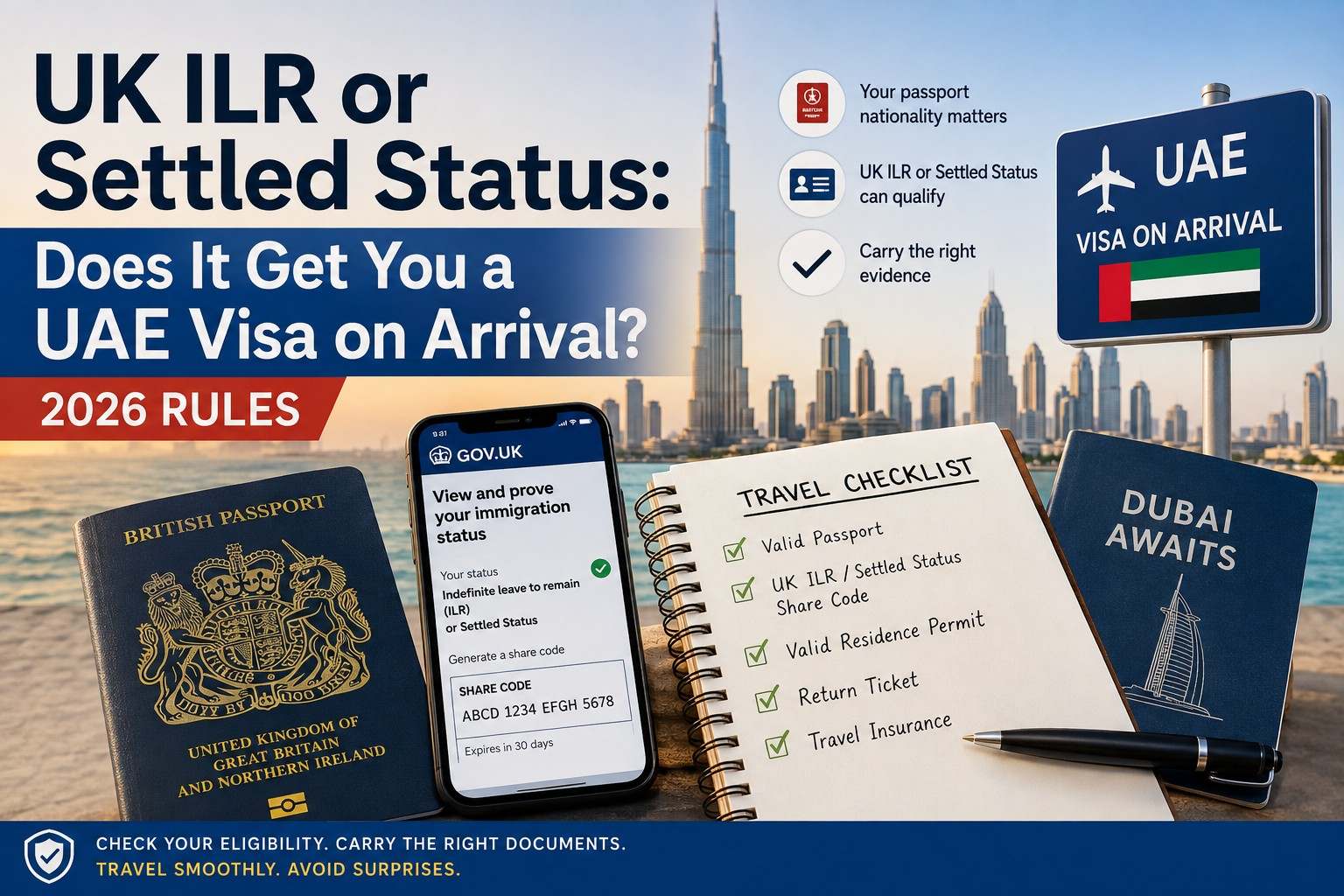
It Depends on Your Passport, Not Just Your UK Status
Holding UK ILR (Indefinite Leave to Remain) or UK Settled Status does not automatically mean you can travel to Dubai without a visa. UAE visa-on-arrival eligibility runs on two conditions at once: your passport nationality and whether you’re carrying a qualifying residence permit from an approved country. ILR and Settled Status can both count as that second condition, but only if your passport is from a nationality the UAE currently recognises for this route. British passport holders don’t need to think about any of this, since their entry is based on their passport only. Everyone else needs to check where their own nationality stands before assuming visa-free entry, which is exactly what the rest of this guide walks through.
British Citizen vs. UK Resident: Two Completely Different Situations
These two groups get lumped together constantly, and it’s the root of most of the confusion around this topic. If you’re travelling on a British passport, you get an automatic Dubai visa on arrival regardless of whether you also hold an ILR or Settled Status. It’s simply not suitable for your case, and you can read our full breakdown of how the Dubai visa-on-arrival process works for UK passport holders.
If you’re a UK resident holding ILR or Settled Status but travelling on a non-British passport, your situation is entirely different. Your eligibility is based on your own passport’s nationality, and whether your UK immigration status is accepted as a qualifying residence permit. That’s the distinction this whole article is built around.
What UK ILR and Settled Status Actually Mean for UAE Immigration Purposes
ILR and Settled Status both grant indefinite permission to remain in the UK, but they come from different legal routes. ILR is usually granted under the Immigration Rules after a qualifying visa period, while Settled Status falls under the EU Settlement Scheme, mainly including EEA and Swiss nationals who were resident in the UK before the end of 2020.
For UAE purposes, this distinction rarely gets spelled out. When the rules refer to “a valid residence permit issued by the United Kingdom”, there’s no published separation between ILR and Settled Status holders. In practice, that means travelers shouldn’t assume one is to have their own evidence of status ready and confirmed before booking, instead of relying on assumptions either way.
| UK Indefinite Leave to Remain (ILR) | UK Settled Status | |
| Legal basis | Immigration Rules (general routes) | Appendix EU / EU Settlement Scheme |
| Who typically holds it | Global migrants after 5 years on a qualifying visa | EEA/Swiss citizens (and eligible family) resident before 31 Dec 2020 |
How it’s evidenced now | UKVI account / eVisa, accessed via share code | UKVI account / eVisa, accessed via share code |
| Is the physical card still valid alone? | No — BRPs have been phased out | No, never had a physical card |
| Lapses after absence of | 2 years | 5 years (4 for Swiss citizens) |
The UK BRP Is Gone: What You Actually Carry Now
Physical BRPs have been phased out, and UK immigration status is now held digitally through a UKVI account as an eVisa. To prove your status to an airline or immigration officer, you’ll need to generate a share code from your UKVI account instead of handing over a card.
Before you travel:
- Log into your UKVI account
- Generate a fresh share code
- Save or print it where it’s accessible
Not every check-in desk or airport system is reliably set up to verify digital status on the spot, so having a share code ready in advance avoids unnecessary delays at the airport.
See the full UAE visa for UK BRP holders requirements.
Does Your Passport Nationality Currently Qualify? (2026 Rules by Group)
This is where things genuinely differ by nationality, and it’s worth checking carefully instead of assuming.
- Group 1–Newly added nationalities: Following the ICP’s announcement on 25 June 2026, ordinary passport holders from the Philippines, Thailand, South Africa, Indonesia, Vietnam, and Kenya became eligible for a UAE visa on arrival, either a 14-day extendable stay or a 60-day single, non-extendable stay, provided they hold a valid residence permit from the UK or one of eight other approved countries. As with any recently updated rule, it’s worth confirming the current status directly on icp.gov.ae close to your travel date.
- Group 2–India: Indian passport holders have traditionally had their own individual visa-on-arrival route tied to residence permits from certain third countries. Several reports from July 2026 suggest the UK-permit pathway specifically may have been narrowed or removed for Indian nationals, while permits from countries like the US, EU, and Canada reportedly remain valid. This hasn’t been independently confirmed against an official ICP source at the time of writing, so Indian passport holders should verify directly with ICP before relying on this route.
- Group 3–Everyone else: UK ILR or Settled Status alone won’t create UAE visa-on-arrival eligibility if your nationality isn’t on either list above. In that case, arranging your UAE tourist visa from the UK in advance is the reliable solution.
Real Traveler Scenarios: What This Means for You
- A British citizen with a UK passport gets an automatic visa on arrival; ILR or Settled Status doesn’t come into it.
- A Filipino passport holder with UK Settled Status currently qualifies under the June 2026 expansion, subject to holding a valid, evidenced permit.
- A South African passport holder with UK ILP similarly qualifies under the same expansion.
- A Thai passport holder with UK Settled Status comes into the same eligible group.
- An Indian passport holder with UK ILR is the case most affected by the reported July 2026 change and should verify directly before booking instead of assuming the old rule still applies.
- Someone holding a passport not on the eligible list, even with UK ILR, will still usually need to apply for a visa in advance; UK status doesn’t override nationality-based requirements.
What to Do If You’re Not Sure You Qualify
Visa-on-arrival eligibility can hinge on details that aren’t obvious from outside, the exact type of permit, its remaining validity, or how a particular airline or airport chooses to interpret the rules on the day. If there’s any doubt, the safer option is to apply for a UAE visa from the UK in advance, which removes the uncertainty entirely and avoids the risk of being turned away at check-in.
Common Mistakes UK Residents Make When Assuming Visa-Free Entry
- Treating ILR and Settled Status as always interchangeable for UAE purposes
- Relying on older blog posts written before the June 2026 rule changes
- Assuming a physical BRP still works instead of share code
- Assuming any UK residence permit helps, regardless of passport nationality
- Not checking that the permit is still valid on the arrival date, not just the booking date
Start your Dubai visa application UK with document review included.
FAQs
Q. Does UK ILR count as a residence permit for a UAE visa on arrival?
A. It can, but only if your passport nationality is one the UAE currently recognises for this route; ILR alone doesn’t guarantee eligibility.
Q. Can I travel to Dubai with UK Settled Status?
A. Possibly, based on your passport nationality; Settled Status is treated similarly to ILR for this purpose, without a published distinction between the two.
Q. Does a UK eVisa work for UAE visa on arrival?
A. Yes, your digital status via a UKVI account share code is the current standard way to evidence your permit, since physical BRPs have been phased out.
Q. Do British citizens need a Dubai visa?
A. No, British passport holders receive an automatic visa on arrival regardless of their UK immigration status. See our full process for UK passport holders.
Q. Can an Indian passport holder with UK ILR get a UAE visa on arrival?
A. This route has reportedly shortened as of July 2026; it’s best to check directly with ICP or check UAE visa rules for Indian passport holders before booking.
CTA
Start your Dubai visa application from the UK — apply online.