
UK eVisa and UAE Visa on Arrival: Does Your Digital Immigration Status Qualify?
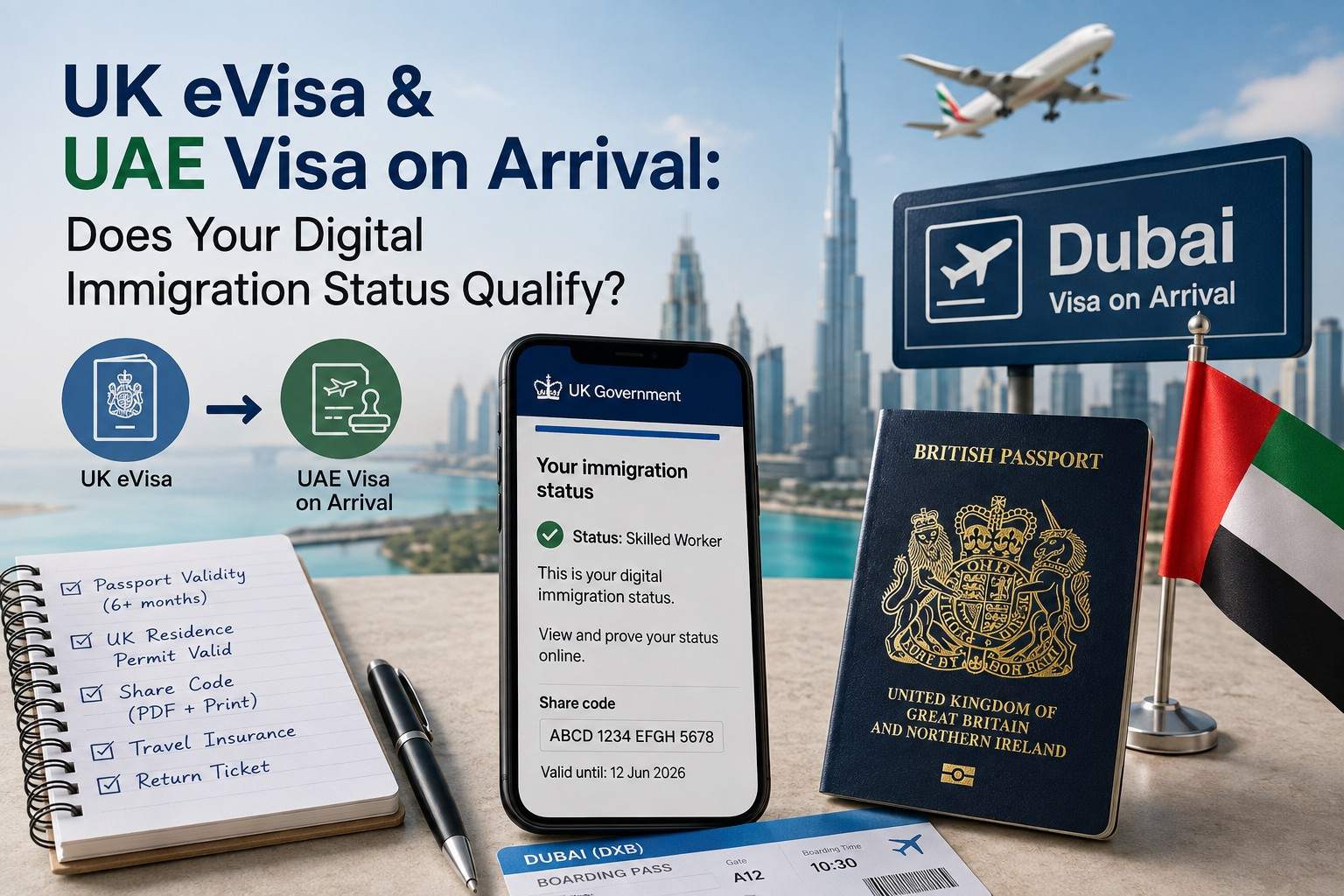
If you’re reading this on your phone the night before you’re due to fly, here’s the short version: having a UK eVisa does not, by itself, get you a UAE visa on arrival. Eligibility runs off your passport nationality first and only then off what your UK status actually represents. British passport holders get visa-on-arrival automatically, no matter what UK status they have. Everyone else needs to check their nationality against the current rules, and for several nationalities, it’s specifically a UK residence permit, not just any UK visa or eVisa that’s required.
What a UK eVisa Actually Proves (and What It Doesn’t)
A UK eVisa isn’t a new type of visa. It’s the digital replacement for the old Biometric Residence Permit card, a live record of your current UK immigration status, held against your UKVI account and shared with third parties through a share code.
What it does not do is tell you whether that underlying status counts as “residence” for UAE purposes. An eVisa can represent settled status, a Skilled Worker grant, a student visa, or it can represent nothing more than a 6-month tourist visit. The word “eVisa” gets used for all of them, which is exactly why this is confusing.
eVisa vs UK ETA: Don’t Confuse These
A UK Electronic Travel Authorisation (UK ETA) is permission to travel to the UK, issued to people who don’t need a visa. An eVisa is a record of an immigration status that you already hold once you’re in the UK. If all you have is an ETA, you have no UK residence status, and it gets you nothing toward UAE VOA eligibility.
eVisa vs BRP: Nothing Changed Except the Format
Your underlying immigration status hasn’t changed, even though you’re still holding an old BRP card that’s now expired. What matters for UAE entry is the status itself, not which document is used to prove it.
The Three Types of “UK eVisa”: Which One Do You Have?
This is the part most guides skip. Not all UK eVisas are equal, actually:
- UK residence-equivalent status: It’s for Skilled Worker, Student, Family visa, Stalled, or Pre-Settled status, Indefinite Leave to Remain (ILR). These usually represent genuine UK residence.
- UK Standard Visitor eVisa: It’s proof that you were permitted to visit the UK, not that you live there. This is the single biggest trap, because it has “eVisa” in the name but isn’t a residence in any meaningful sense.
- No UK immigration record at all: ETA-only, or visa-free UK visit under the old rules. Irrelevant to UAE VOA either way.
| UK status type | Counts as a UK resident? | Typical UAE relevance |
Settled / Pre-Settled status | Yes | Can support VOA where a residence permit is required |
| ILR | Yes | Can support VOA where a residence permit is required |
Skilled Worker / Student / Family Visa | Yes | Can support VOA where a residence permit is required |
| Standard Visitor eVisa | No | Does not satisfy residence-permit requirements |
| ETA-only / no visa history | No | No bearing on UAE VOA |
Need help choosing the correct UAE visa route? Contact UAE Visa Travel before submitting your application.
UAE Visa-on-Arrival Rules by Passport Nationality (Where UK Status Matters)
Here’s the part people get wrong most: only a handful of nationalities have a VOA rule that references a foreign residence permit at all. For most nationalities, UK status doesn’t come into it either way.
Indian Passport Holders
Indian passport holders can access a 14-day VOA facility tied to holding a valid US, UK, or EU Visa or residence permit, along with an online pre-approval step introduced in 2024. Current reporting is genuinely mixed on whether the UK route within this facility is still active. Don’t book around it. Verify directly with GDRFA Dubai or ICP before you rely on it.
Scenario: an Indian passport holder with a UK Skilled Worker eVisa, flying to Dubai next month, should check the current India-UK VOA status through official channels before assuming it still applies.
Filipino, Thai, South African, Vietnamese, Indonesian, and Kenyan Passport Holders
From 25 June 2026, this group gained access to a 14- or 60-day VOA, conditional on holding a valid residence permit (not merely a visa) from the UK or another approved country, plus a six-month validity requirement on that permit, per GDRFA Dubai’s official announcement. The bar here is stricter than India’s standard Visitor-only eVisa will not satisfy it.
Scenario: a Filipino passport holder with a UK Student eVisa (residence-equivalent) applying under the June 2026 rule is likely eligible, provided the six-month validity check holds up.
Scenario: a South African passport holder with a UK Standard Visitor eVisa only—someone who’s visited the UK once but doesn’t live there does not qualify under the residence-permit requirement and needs a pre-arranged visa instead.
Related reading: South African passport holders’ Dubai visa guide and Thailand passport holders’ Dubai visa options.
Pakistani, Nigerian, Bangladeshi, and Other 30-Day VOA Nationalities
The standard 30-day VOA rule doesn’t reference UK residence status as a qualifying condition at all for this group. UK immigration status simply isn’t part of the eligibility test here, so a UK eVisa changes nothing, one way or the other.
Scenario: a Pakistani passport holder living in the UK on an eVisa can skip this whole discussion, and their UK status is irrelevant to their VOA rule, and they should go straight to Dubai visa options for Indian passport holders-style standard tourist visa guidance for their own nationality.
British Passport Holders
If you hold a British passport, none of the above applies to you. You get the 90-day VOA regardless of any UK immigration status, because eligibility here runs entirely off passport nationality.
What to Actually Carry and Show at UAE Immigration
Your status being digital doesn’t mean you turn up empty-handed. Here’s what to actually do before you leave for the airport:
- Save your share code as a PDF, and print a copy too. Don’t rely on a screenshot—screenshots can be outdated the moment your status changes, and a share code has an expiry window. A fresh PDF plus a paper printout covers you either way.
- Know your UKVI account login off by heart, or save it somewhere offline. If a border officer needs to re-verify anything, you’ll want to get in fast, not be scrambling to reset a forgotten password on airport wifi.
- Check your passport has at least 6 months’ validity left from your arrival date. This trips people up constantly, and it’s a hard requirement—not a guideline.
- Remember that your airline checks your documents separately from UAE immigration, and airline staff is sometimes stricter or less familiar with eVisas than border officers are. Don’t assume that getting through check-in means you’re automatically fine on arrival.
The real risk with a fully digital status is depending on your phone alone. Batteries die, connectivity drops, and you can’t count on airport wifi being fast — or working — right when you need it. A printed backup takes two minutes and removes that risk completely.
If You’re Not Sure You Qualify: What to Do Before You Book
If your UK status is Standard Visitor-only, if your passport nationality isn’t on any VOA-linked list, or if you can’t get a clean confirmation from an official source in time, don’t gamble on it at the airport. Apply for a pre-arranged UAE tourist visa instead. It removes the risk of a boarding denial or an on-arrival refusal entirely, and it’s a far less stressful way to travel.
FAQs
Q. Does a UK eVisa let me get a UAE visa on arrival?
A. Not by itself. Eligibility is based on your passport nationality and then on whether your UK status counts as genuine residence rather than a visitor record.
Q. What’s the difference between a UK eVisa and a UK ETA?
A. A UK ETA is permission to travel to the UK; a UK eVisa is a digital record of an immigration status you already hold once inside the UK. An ETA alone gives you no UAE VOA advantage.
Q. Does a UK Standard Visitor visa count as UK residence for UAE entry?
A. No. It proves you were permitted to visit the UK, not that you live there, and it won’t satisfy residence permit-based VOA requirements.
Q. Can Indian passport holders still use a UK visa for a UAE visa on arrival?
A. Possibly, but reporting on this specific route is currently mixed. Verify directly with ICP or GDRFA Dubai before relying on it.
Start your UAE visa application—remove the uncertainty before you fly.