
Dubai Visa for Canadian Citizens vs. Canadian PR Holders: What’s the Real Difference?
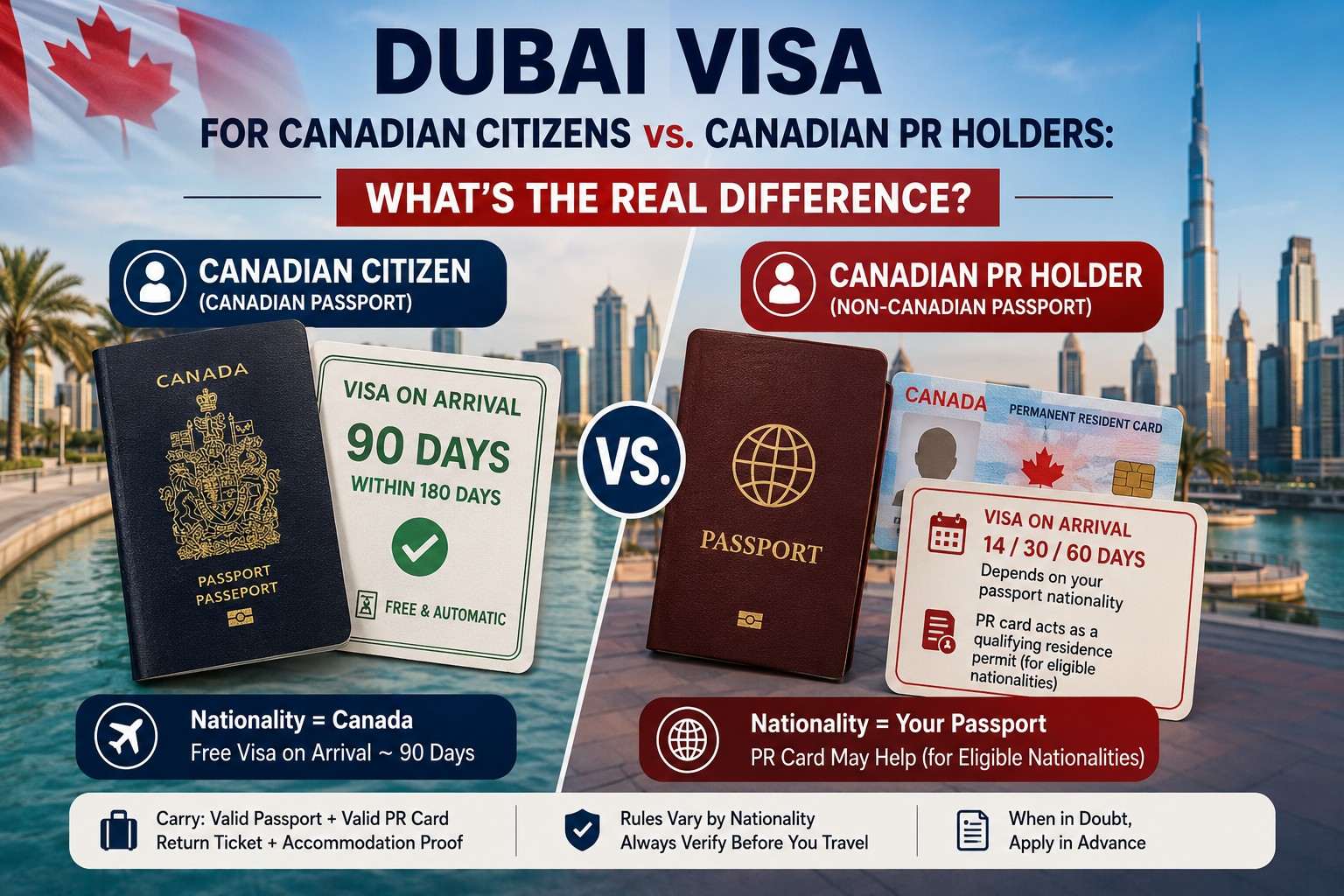
If you’re planning a trip to Dubai and you hold Canadian permanent residency, here’s the short version: your Dubai visa eligibility is decided by the passport in your hand, not by your Canadian status. Canadian citizens traveling on a Canadian passport get a free, automatic visa on arrival. Canadian PR holders traveling on their own country’s passport are assessed under that passport’s rules first. Canadian PR only comes into play afterwards, and only for certain nationalities. In plain terms: Canadian PR is not the same as Canadian citizenship for entry to the UAE, and mixing the two up before you book can genuinely cost you your trip.
Canadian Citizen vs. Canadian PR Holder — Why the UAE Treats Them Differently
It helps to understand why this distinction exists at all. UAE visa policy is negotiated bilaterally, country by country; it’s built around nationality, not residency. When you hold Canadian citizenship, you carry a Canadian passport, and that passport is the nationality the UAE has agreements with. Canadian PR, on the other hand, is a status granted by IRCC to someone who lives in Canada. It doesn’t prove that you’re Canadian.
Comparison Table: Dubai Visa Rules by Traveler Type
| Factor | Canadian Citizen (Canadian passport) | Canadian PR Holder (non-Canadian passport) |
| What determines eligibility? | Passport nationality (Canada) | Passport nationality (their own country) |
| Base UAE visa-on-arrival | Yes, automatic, free | Depends entirely on their passport’s own base rule |
| Role of Canadian PR | None needed | Can act as a “qualifying residence permit” for specific nationalities |
| Typical stay on arrival | ~90 days within 180 days | 14, 60, or 30 days, depending on the route (verify per nationality) |
| VOA fee | Free | Fee-based where applicable (e.g., ~AED 100, verify) |
| Document to carry | Valid Canadian passport | Own passport + valid Canadian PR card (or PRTD) + return ticket + accommodation proof |
| If the qualifying route doesn’t apply | N/A | Pre-arranged UAE visa required |
If You’re a Canadian Citizen Traveling on a Canadian Passport
As a Canadian citizen on a Canadian passport, you get a free visa on arrival for roughly 90 days within any 180 days, valid at DXB, AUH, and other UAE entry points, subject to the usual passport-validity and onward-travel conditions. One genuine exception worth flagging: temporary or refugee travel documents issued by Canada don’t qualify for this treatment; only a standard Canadian passport does. If you’d rather not deal with arrival queues, or you’re traveling with children or elderly family members, a pre-arranged visa is an optional convenience worth considering. See our full Canada visa requirements and fees for the complete details.
Prefer to skip the arrival queue? Apply for your Dubai visa from Canada in advance.
If You Hold Canadian PR but Travel on a Different Passport
Here’s where most people get it wrong. Eligibility starts from your passport’s nationality, not from your PR status. Canadian PR can matter in 2 ways:
The qualifying-permit route: For a specific list of nationalities, a valid Canadian PR card can serve as a “qualifying residence permit” that unlocks a conditional visa on arrival that wouldn’t otherwise exist for that passport.
Not sure your Canadian PR card qualifies? Check your UAE visa eligibility before you book.
No effect at all: If your passport already gets free VOA independently or isn’t on any qualifying list, your Canadian PR changes nothing. In that case, an advanced UAE visa remains the reliable route.
To be clear: this is not a blanket ‘PR equals visa-free” rule. It only applies where your specific nationality is listed.
Which Nationalities Can Use Canadian PR as a Qualifying Permit?
This is the part most Canada-focused articles skip entirely.
- 14-or-60-day VOA group (added 25 June 2026): Philippines passport holders, Thailand, Indonesia, Vietnam, Kenya, and South Africa using an ordinary passport plus a valid residence permit from one of nine approved countries, including Canada.
- India: an existing 14-day VOA facility, extendable once, using a valid residence permit from Canada or one of eight other approved countries; fee-based at roughly AED 100. See Indian passport holders traveling to Dubai.
- Broader 30-day VOA group: Pakistan, Bangladesh, Egypt, Georgia, Kazakhstan, Nepal, Nigeria, Sri Lanka, Ukraine, and most other nationalities not listed above, under the same nine-country qualifying-permit rule.
For the South Africa-specific angle, see South African travelers’ Dubai visa route, and for the full policy context behind this expansion, read our full breakdown of the 2026 visa-on-arrival expansion. These lists can and do change, so always check against ICP or MOFA before you book.
What Counts as Proof: PR Card vs. PR Status vs. Passport
PR status itself is permanent, barring loss or renunciation. The PR card is a physical document that expires every five years and needs renewing. An expired card doesn’t end your status — but it’s still a real problem at check-in, because airline staff and UAE immigration generally need to see a valid document, not just take your word for it.
What to carry: your own passport, a valid Canadian PR card, your return or onward ticket, and proof of accommodation. Worth noting: airline check-in verification and UAE immigration eligibility can differ in practice, which is a genuinely documented risk, not a hypothetical one.
Traveler Scenarios — Same Household, Different Dubai Visa Rules
- Canadian citizen, Canadian passport: free 90-day VOA, no PR question ever arises.
- Indian citizen with Canadian PR, Indian passport: base passport doesn’t get automatic VOA; a valid PR card unlocks the 14-day conditional VOA.
- Filipino citizen with Canadian PR, Philippine passport: qualifies for the new 14-or-60-day conditional VOA since June 2026.
- Pakistani citizen with Canadian PR, Pakistani passport: falls under the 30-day qualifying-permit group.
- Bangladeshi citizen with Canadian PR, Bangladeshi passport: same 30-day group.
- South African citizen with Canadian PR, South African passport: part of the same 2026 expansion group.
Each traveler’s outcome hinges on one thing: their own passport, checked against the qualifying list and what happens if their PR card has quietly expired.
Common Mistake — Assuming Canadian PR Works Like a Canadian Passport
The mistake is booking a trip assuming a free, guaranteed VOA “because I live in Canada”. The reality is that airlines check documents against destination rules, and denied boarding or refusal of entry is a real risk when the qualifying conditions aren’t met. The opposite mistake happens too: assuming PR never helps and paying unnecessarily for a visa type a PR-based VOA route would have covered anyway. The fix is simple: check your eligibility against your actual passport before you book, not after. For the safer route, see our step-by-step process for applying in advance.
When a Pre-Arranged UAE Visa Is the Safer Choice
If your qualifying-permit eligibility is uncertain, your PR card is borderline on renewal, or you’re travelling with daily members whose documents differ, applying in advance removes the guesswork entirely. This applies to any PR-holder nationality not on the qualifying lists above. You can apply for a Dubai visa from Canada directly, or message us on WhatsApp to check your eligibility before you book.
FAQs
Q. Do Canadian PR holders need a Dubai visa?
A. It depends on their own passport’s nationality, and Canadian PR alone doesn’t grant visa-free entry.
Q. Can a Canadian PR card replace a Canadian passport for UAE entry?
A. No, it can only act as a qualifying residence permit for certain nationalities, not as a substitute passport.
Q. Does an expired PR card affect a Dubai visa on arrival?
A. Yes, an expired card is usually not accepted as proof, even though PR status itself doesn’t expire.
Q. Is the qualifying-permit list the same for every nationality?
A. No, duration and fees vary by nationality and can change without notice, so always verify with ICP or GDRFA before travel.