
Can I Apply for a UAE Visa Without a Return Ticket?
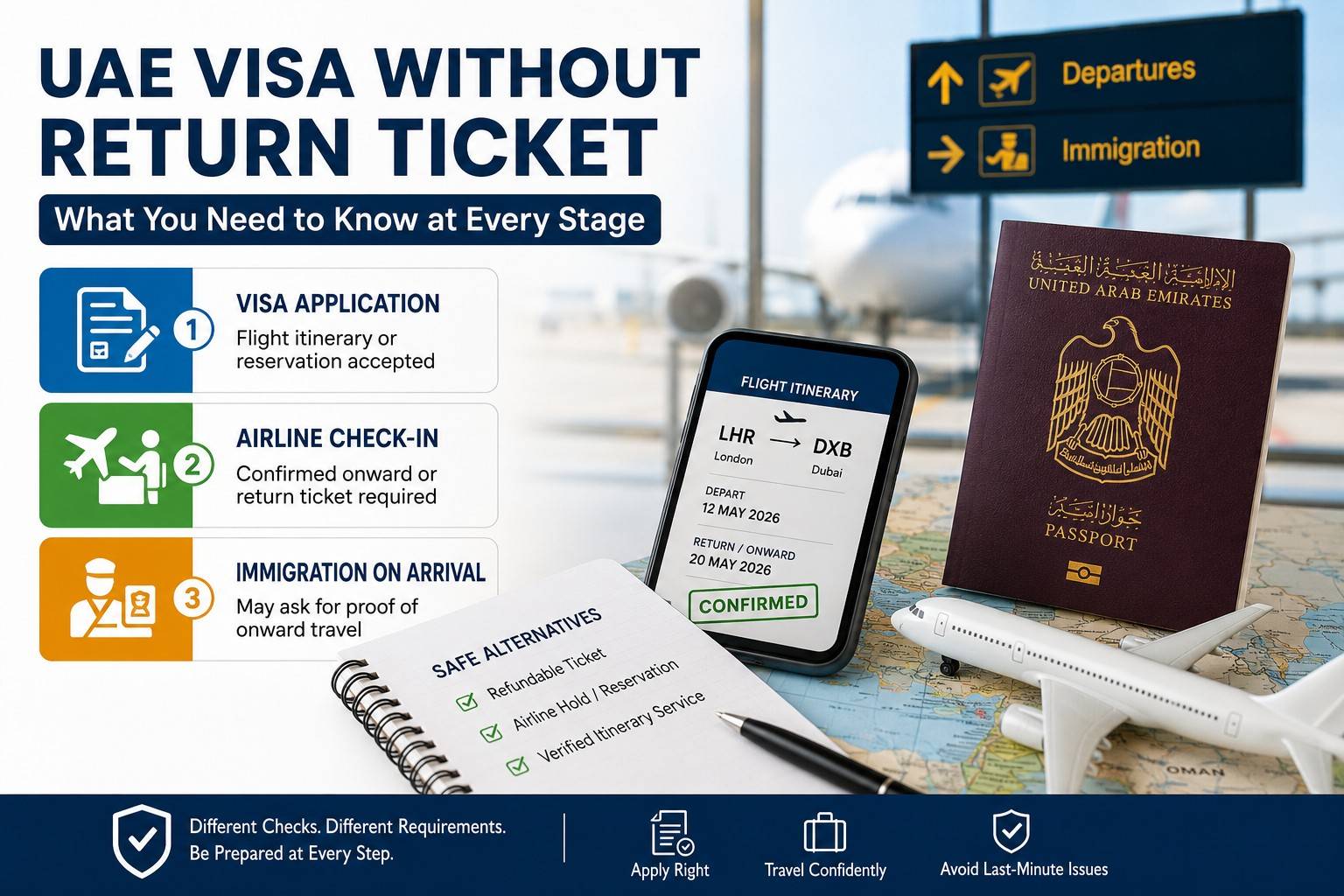
You can usually submit a UAE visa without a return ticket, but that’s the only part of the journey. A flight itinerary is usually enough at the application stage, yet a proper onward ticket is often required at airline check-in and can come up again at immigration on arrival. In other words, visa approval and being allowed to fly are two separate checks, handled by two different parties, and mixing them up is where most of the confusion and the occasional stranded traveler come from.
Quick Answer: What You Actually Need at Each Stage
| Stage | Who checks | What’s typically needed |
| Visa application | Visa authority/portal | Flight itinerary or reservation (not necessarily paid) |
| Airline check-in | The airline | Confirmed onward or return ticket, in most cases |
| Immigration on arrival | UAE immigration | May ask for proof of onward travel as part of a wider check |
This is the three-checkpoint framework worth keeping in mind throughout: application, check-in, arrival. A document that satisfies one doesn’t automatically satisfy the other two. If you want the details and what’s needed overall, our UAE tourist visa requirements page covers the complete list.
Do You Need a Return Ticket to Apply for a UAE Visa?
Most portals ask for a flight itinerary instead of proof of a fully paid ticket at the application stage. A provisional or reserved booking is commonly accepted here, since the point of this step is simply to show intended travel dates, not to lock in your flight months in advance. That said, exact requirements can differ slightly between visa portals and processing agents, so it’s worth confirming with whoever is handling your UAE visa without a return ticket application before you rely on this.
For the complete document breakdown, see our full list of required visa documents.
What Counts as an “Onward” or “Return” Ticket?
An onward ticket for a UAE visa simply means that any flight leaving the UAE after the visit. It doesn’t have to be a return to your home country. If you’re continuing on to a third country afterward, that onward leg counts just as well as a direct return flight home.
Can I Submit a Provisional or Reserved Booking Instead?
Yes. A reserved booking reference (PNR) without full payment is accepted for the application itself. The catch is that this isn’t guaranteed across every agent or portal, and a reservation that isn’t backed by an actual paid ticket won’t help you later at check-in. Treat it as sufficient for the application stage only, not as something to rely on right through to boarding.
Check your UAE visa eligibility before you apply.
What Is a “Dummy Ticket”: And Should You Use One?
A dummy ticket, sometimes called a flight reservation ticket, is a temporary booking confirmation generated without actual payment and used purely to show an itinerary. That’s different from a fraudulent or forged booking, which is a document altered or fabricated to look like a real ticket. This line between the two matters. Some airlines and immigration checks can flag inconsistencies in reservation-only documents, and if a document turns out to be forged instead of simply provisional, it can affect not just this application but future ones too.
A common myth worth debunking here: a dummy ticket isn’t risk-free just because it’s widely used. Acceptance can vary by airline and by immigration officer discretion on the day. The safer route, if you want to avoid any doubt, is a refundable real ticket or a verified reservation service instead of a document you’re not fully sure will hold up. For a broader look at what can derail an application, our common UAE visa rejection reasons page is worth a read.
Does the Airline Check Your Return Ticket at Boarding?
This is the checkpoint where most travelers actually get caught out, not immigration, but the airline. Airlines can face fines for carrying passengers who are later refused entry at their destination, which is exactly why many enforce onward or return ticket checks strictly at check-in, regardless of whether your visa has already been approved. Visa approval tells the airline you’re allowed to enter the UAE; it says nothing about whether you’ve a way to leave, and that second question is the airline’s own liability to manage.
What Happens If You Only Have a One-Way Ticket?
You risk being denied boarding entirely, even with an approved visa in hand. This comes down to airline discretion: some check consistently, some are stricter on certain routes, but it’s not a risk worth testing at the gate. This is distinct from an immigration risk; it’s purely the airline protecting itself from potential fines.
ECR Passport Holders and the OTB Requirement
For ECR (Emigration Check Required) passport holders, some airlines and processing points need an OTB (On Travel Basis) remark before travel is confirmed, tied to onward travel proof. Exact carrier requirements change, so this is one to verify directly with your airline or agent before you finalise anything. Indian travelers in particular should check our UAE visa requirements for Indian travelers page for the fuller context.
Will UAE Immigration Ask for Your Return Ticket on Arrival?
Possibly, though it’s rarely an isolated check. Immigration officers on arrival may ask for proof of onward travel alongside other genuine traveler indicators such as accommodation details, sufficient funds, and purpose of visit. Think of it as part of a broader assessment rather than a single document that makes or breaks entry on its own.
Refundable vs. Non-Refundable vs. Provisional Tickets: Which Should You Book?
| Ticket type | Cost | Risk | Typically accepted at |
| Refundable ticket | Higher upfront, refundable if plans change | Low | Application, check-in, arrival |
| Non-refundable ticket | Cheapest, but locked in | Medium — costly if dates shift | Application, check-in, arrival |
| Provisional/reserved booking | Low or no cost | Higher — may not satisfy check-in | Application only, in most cases |
Rules and airline policies can change, so it’s worth verifying current requirements directly with your airline or visa processor before booking, instead of assuming last year’s experience still applies.
Common Mistakes Travelers Make With Return Tickets
Booking a return date that comes after your visa validity expires is a surprisingly common slip, and the ticket itself might be fine, but it no longer lines up with your permitted stay. Others rely on a payment receipt instead of an actual confirmed booking, which airlines won’t accept as proof. Submitting a forged or altered ticket document is a serious mistake that can jeopardize future applications, not just the current one. And the most frequent misunderstanding: Assuming visa approval alone guarantees boarding, when it’s really only step one of three. For more on avoiding these pitfalls altogether, see avoid these UAE visa rejection mistakes.
FAQs
Q. Do I need a return ticket for a UAE visa?
A. Not usually for the application itself, but you’ll likely need one at airline check-in.
Q. Can I apply for a UAE visa with a one-way ticket?
A. Yes. Applications commonly accept a one-way or provisional itinerary, and the check-in requirements are separate.
Q. Is a dummy ticket accepted for a UAE visa application?
A. It’s not guaranteed to satisfy airline check-in requirements later.
Q. Does the airline check my return ticket even if my visa is approved?
A. Yes. The visa approval and airline boarding checks are handled separately.
Q. Can my UAE visa be rejected because of a missing return ticket?
A. It’s less commonly the application that’s affected, and the bigger risk lies at check-in and arrival.
Final Takeaway: What Should You Do Right Now?
Always keep the three checkpoints in mind: what your visa application needs, what your airline needs at check-in, and what immigration might ask on arrival. They’re not the same requirement, wearing different names, and treating them as one thing is where most last-minute problems start.